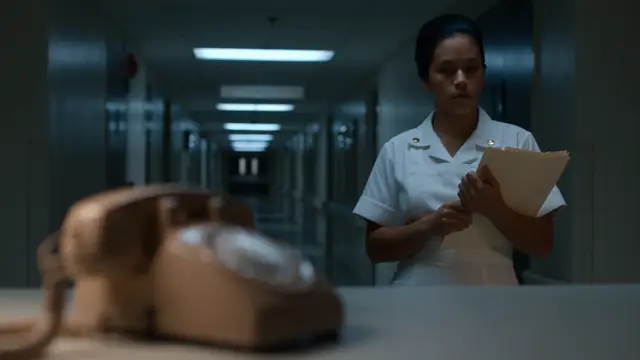
 C1New
Rack focus
shift attention from object to person (or back); connect a clue to its owner

A crash zoom in snaps the lens from wide to tight in an instant. What it's for: shock, a punchline, a stinger; 1970s action grammar.
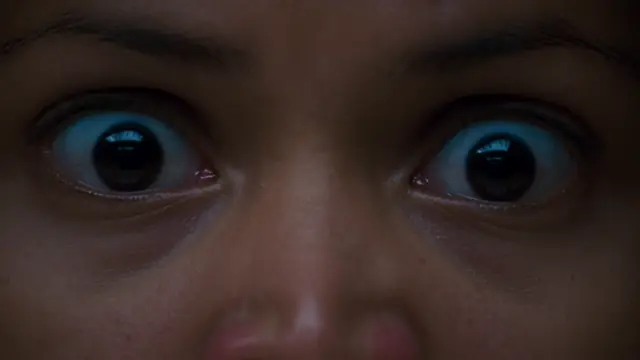 C4
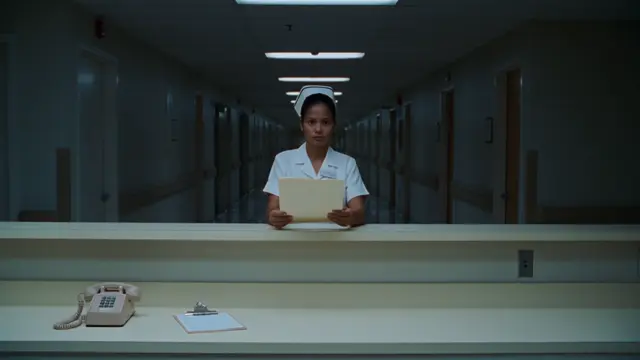
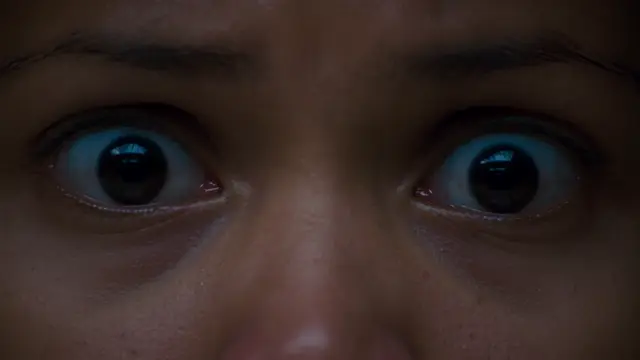
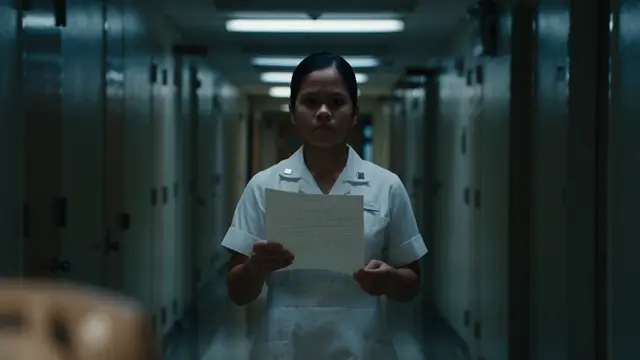
Scene paragraph Night in a long hospital corridor, photoreal medical thriller, 35mm film look. A young Filipina nurse with her black hair in a bun, wearing a white nurse's uniform, stands behind a nurses' station at the far end of the corridor, in the middle of the frame looking toward the lens, holding a paper chart. Behind her the corridor runs straight back to a distant vanishing point, rows of doors and ceiling lights receding. A cream rotary phone sits on the counter in the near foreground at lower left. Cool fluorescent light.
Medium-wide shot at eye level, the camera locked on a tripod. 0–2s: the frame holds wide as she reads the chart. 2–3s: she drops the chart and the lens crash-zooms in, snapping from wide to an extreme close-up of her eyes in a fraction of a second. 3–6s: the frame jolts once and settles on her wide, frightened eyes. 6–8s: it holds on her eyes as she stares at something behind the camera. Throughout: one sudden snap zoom from a fixed position, one continuous take.
Give the snap a trigger. She drops the chart, the lens snaps: the action motivates the zoom.
Other direction: Crash zoom out
Pairs with: Panic · Spinning back kick
C1Newshift attention from object to person (or back); connect a clue to its owner
 C2
quiet attention, a realization; the 1970s observational look
 C2b
let the edges of the frame reveal the joke or the truth; the 1970s observational look