 D2
Tilt up
reveal height, power or scale; follow a gaze upward

A static shot locks the camera on a tripod with no movement. What it's for: let the blocking and performance carry the scene; build tension by refusing to move.
 D1
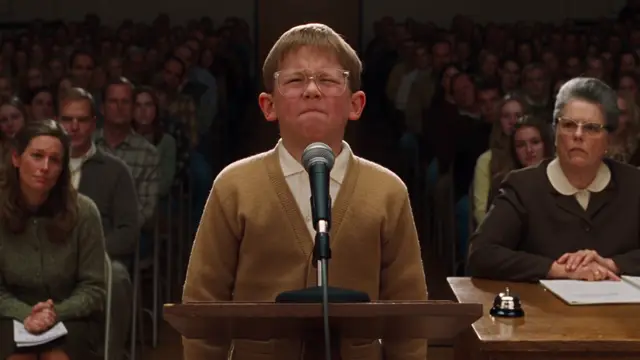
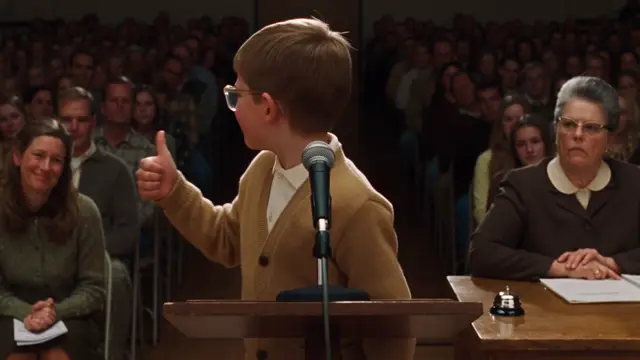
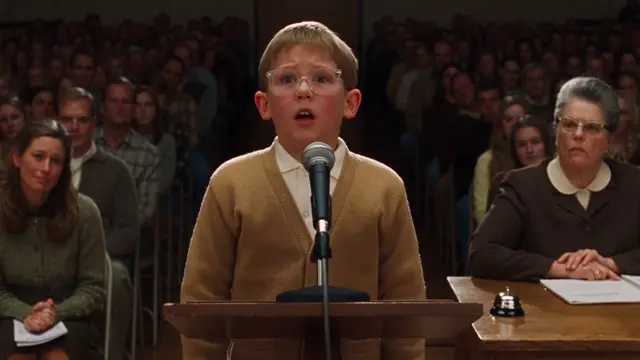
Scene paragraph A school spelling bee in a packed gym on a weekday evening, photoreal comedy, warm gym lights over rows of folding chairs. In the center a nervous ten-year-old boy with glasses and a brown cardigan stands at a microphone on a small stage. To screen right sits the head judge, a stern gray-haired woman with half-moon glasses, at the judging table with a small silver bell; to screen left, in the front row of the audience, sits his mother in a green sweater, clutching a program. Live-action footage shot on 35mm film, real people, natural skin and textures.
Medium shot of the boy at the microphone, the camera locked on a tripod. 0–2s: he squints at the ceiling, thinking hard. 2–4s: he starts spelling, counting the letters off on his fingers. 4–6s: he loses count, freezes, and starts the word over from the beginning. 6–8s: he finishes, lets out a huge breath and gives a hopeful thumbs-up. Throughout: the frame stays exactly the same from a fixed camera, one continuous take.
A static shot still needs an event. Let the performance or the blocking do the moving.
Pairs with: Embarrassment · Lights out, one source left
D2reveal height, power or scale; follow a gaze upward
 D2b
follow a fall or a gaze downward; find what waits at the bottom
 D3
connect a cause to its effect, a line to its reaction; comic timing